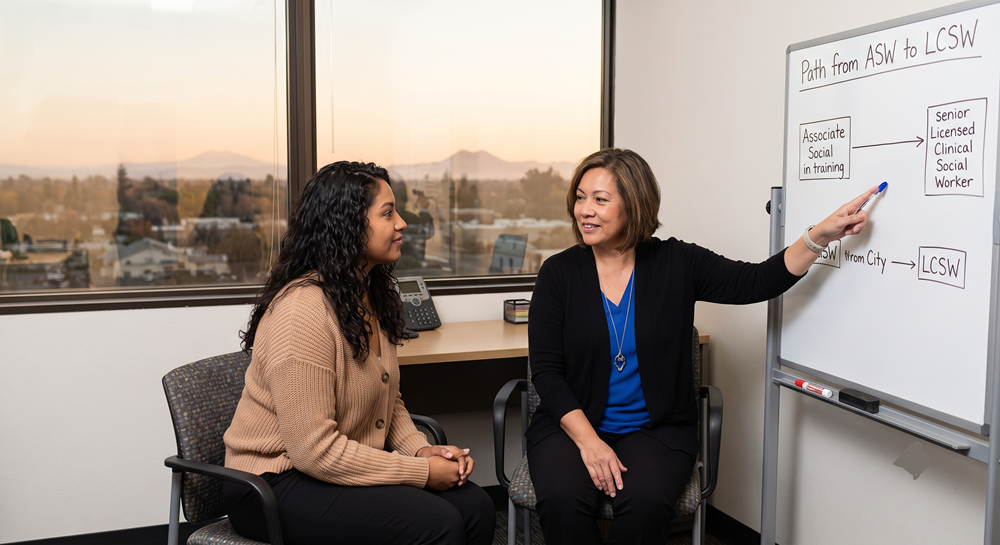
Becoming a Licensed Clinical Social Worker is one of the most versatile and meaningful career paths in mental health — and it begins with your years as an Associate Clinical Social Worker. High-quality associate social worker training gives you the supervised experience, clinical skill, and professional confidence you need to thrive. If you've registered as an ASW and you're looking for great clinical supervision that will carry you toward LCSW licensure, this guide covers what training license clinical social workers involves and how to build a strong foundation for your career in the Yuba City area.
What Associate Social Worker Training Involves

Photo by Hannah Busing on Unsplash
As an Associate Clinical Social Worker, you work toward LCSW licensure by accumulating supervised clinical experience under a qualified clinical supervisor. What distinguishes the clinical social work path is its emphasis on understanding the whole person within their environment — the interplay between an individual's mental health and the social, economic, family, and community systems that surround them.
Training license clinical social workers involves developing skills across a remarkably broad range of settings and populations. ASWs often gain experience in community mental health, medical settings, schools, and private practice — building a versatile clinical toolkit that reflects social work's holistic, systems-aware philosophy. This breadth is one of the profession's greatest strengths.
Key Requirements on the ASW Path
Always confirm current specifics with the California Board of Behavioral Sciences (BBS), but the ASW path generally includes these core components:
For a side-by-side look at how the ASW path compares to the AMFT and APCC routes, see our overview of training for associates in Yuba City.
How to Find Great Clinical Supervision for Your ASW Training
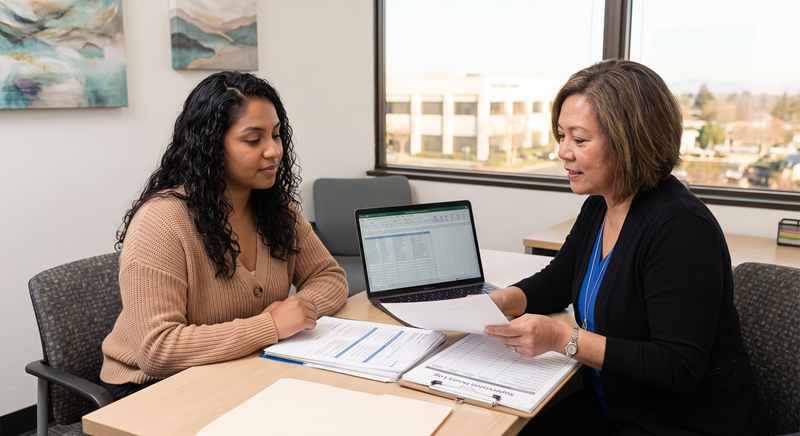
Finding great clinical supervision is the single most important factor in a smooth, rewarding ASW experience. The supervisor you choose will shape your clinical judgment, your confidence, and your entire path to licensure. Here's how to approach the search:
- Confirm they can supervise ASWs. Your supervisor must meet BBS requirements for supervising Associate Clinical Social Workers, including the appropriate license and supervision training.
- Look for clinical depth. Seek a supervisor whose expertise spans the kinds of clinical work you want to grow in — trauma, anxiety, depression, and beyond.
- Ask about specialization. If developing skills in EMDR or trauma work matters to you, confirm your supervisor can mentor you in those areas specifically.
- Assess the workplace culture. A healthy, supportive environment with sustainable caseloads makes an enormous difference to your development and wellbeing.
- Meet before committing. A short consultation tells you whether a supervisor's style and values align with yours. The supervisory relationship is central to your growth — fit matters.
A note on developing a specialty: Clinical social workers who build expertise in trauma and EMDR during their training are exceptionally well-positioned once licensed. Trauma-informed practice aligns beautifully with social work's whole-person philosophy — and supervision that supports EMDR development gives your career a meaningful edge. Learn more about how EMDR therapy works.
From ASW to LCSW: Getting Your Therapist's License
Reaching the point where you get your therapist's license and become a fully licensed LCSW is a landmark achievement. It represents thousands of hours of supervised clinical work, deep personal growth, and readiness to practice independently and even supervise others one day. But the smoothness of that journey depends heavily on where and how you complete your associate social worker training.
ASWs who train under invested supervisors, in healthy workplaces, with support for tracking their social work licensing hours, consistently reach licensure more efficiently and confidently. Those in unsupportive settings too often stall or burn out. Choosing the right environment for your associateship is one of the most important early-career decisions you'll make — so choose it with care.
To understand exactly how supervised hours accumulate, see our guide to tracking therapy supervisor hours, and explore the clinical work our team is passionate about on our services page.
Pursuing associate social worker training in Yuba City?
Everyday Counts Therapy Services is building a supervision and training program to support ASWs on the path to LCSW licensure.
Serving ASWs Across Yuba City and Sutter County
Everyday Counts Therapy Services proudly supports Associate Clinical Social Workers throughout Yuba City, Marysville, Linda, Olivehurst, Live Oak, and the broader Sutter-Yuba region. Whether you're just beginning your associateship or nearing the end of your supervised hours, the right training environment can transform your path to LCSW licensure.
If you're ready to train in a supportive, growth-focused practice with real opportunities to develop your specialty, reach out to our team today — and watch for the launch of our Training for Associates program.
Everyday Counts Therapy Services · 1445 Butte House Road, Suite A & 1007 Live Oak Blvd, Suite B-1 · Yuba City, CA 95993 · (530) 770-1242 · Supporting associate therapists across the Yuba-Sutter region.