It's a fair and important question: is EMDR backed by science, or is it just another wellness trend? As a clinician who has used Eye Movement Desensitization and Reprocessing (EMDR) for years, I think healthy skepticism is a good thing — you should want evidence before trusting any treatment with your mental health. The short answer is yes: EMDR is one of the most thoroughly researched psychotherapies available, and it's endorsed by some of the world's most rigorous health authorities. Let me walk you through what the evidence actually says, in plain terms.
Is EMDR Backed by Science? What the Major Authorities Say
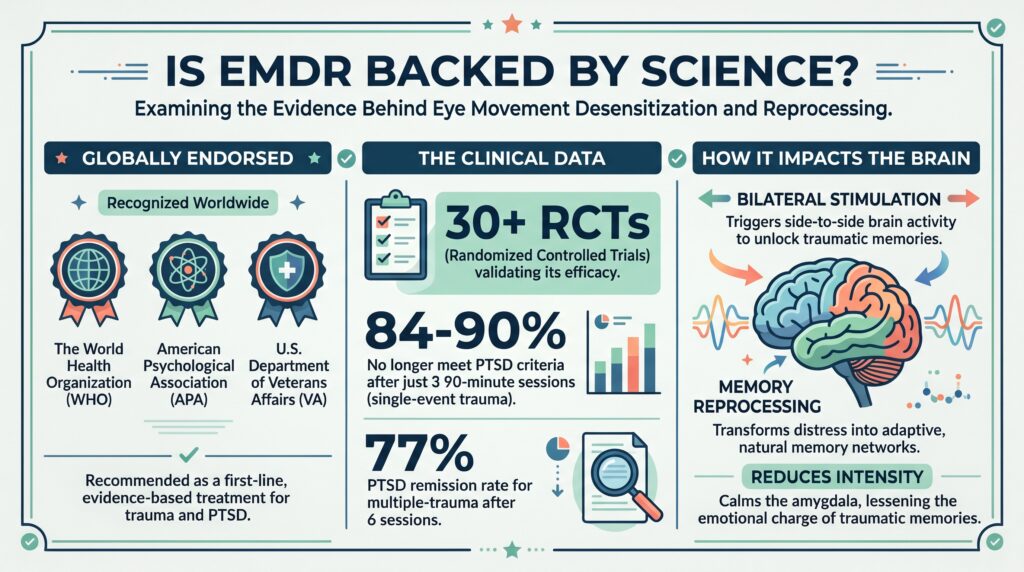
EMDR isn't endorsed by a single organization — it's recognized across many of the most respected bodies in global mental health. Here's where it stands:
When this many independent authorities — reviewing the same body of research through different lenses — arrive at the same conclusion, it reflects a genuine scientific consensus, not a passing trend.
What Does the Research Actually Show?
Decades of controlled studies — including numerous randomized controlled trials, the gold standard in clinical research — have examined EMDR. The findings consistently show that EMDR can significantly reduce the symptoms of PTSD and trauma, often in fewer sessions than some other approaches for single-incident trauma. Researchers have also studied its use for anxiety, depression, and other conditions, with growing supportive evidence.
I want to be honest and balanced here, because trustworthy information requires it: scientists are still studying exactly why the bilateral stimulation in EMDR works. There are leading theories — connections to how the brain processes memory during REM sleep, and the effects of dual attention on working memory — but the precise mechanism is still an active area of research. What's well established is that it works; the deeper "why" continues to be studied. That's true of many effective medical and psychological treatments.
Why this honesty matters: A treatment doesn't need every mechanism fully mapped to be proven effective and safe — aspirin was used for decades before science fully understood how it worked. What matters is that rigorous, repeated studies show EMDR helps, and that it's delivered by a trained clinician. For a plain-language overview of the method itself, see our guide on how EMDR therapy works.
What This Means for You
If you're considering EMDR, you can do so knowing it rests on a solid scientific foundation. That said, evidence for a treatment in general doesn't replace personalized care. A skilled, trained clinician will assess whether EMDR is right for your situation, prepare you thoroughly, and integrate it with other approaches as needed — which is exactly how we practice at Everyday Counts.
EMDR is one of my core approaches, and several clinicians on our team incorporate it as well. We use it to help with trauma and abuse, complex PTSD, anxiety, and depression.
Curious whether evidence-based EMDR could help you?
Everyday Counts Therapy Services offers EMDR therapy in Yuba City — in person and via telehealth. New clients welcome.
- World Health Organization — Guidelines for the management of conditions related to stress (PTSD): who.int
- American Psychological Association — Clinical Practice Guideline for the Treatment of PTSD: apa.org
- U.S. Department of Veterans Affairs / DoD — Clinical Practice Guideline for PTSD: healthquality.va.gov
- EMDR International Association — Summary of EMDR research: emdria.org
About the author: Kendra Davis, LCSW, is the founder and clinical supervisor of Everyday Counts Therapy Services in Yuba City, CA. EMDR and Trauma-Informed CBT are among her core clinical approaches. She is licensed by the California Board of Behavioral Sciences and has over 20 years of experience.
Everyday Counts Therapy Services · 1445 Butte House Road, Suite A & 1007 Live Oak Blvd, Suite B-1 · Yuba City, CA 95993 · (530) 770-1242 · Most insurance accepted · In-person & virtual sessions available.
If you or someone you know is in a life-threatening or urgent situation, please call 911, the 988 Suicide & Crisis Lifeline, or the 24-hour Sutter-Yuba Behavioral Health crisis line at 888-923-3800.